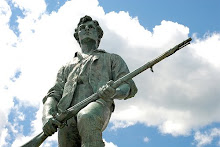
"If Congress can do whatever in their discretion can be done by money, and will promote the General Welfare, the Government is no longer a limited one, possessing enumerated powers, but an indefinite one...." -- James Madison
Today's Supreme Court ruling on the Obamacare and the Individual Mandate marks a black day in our history. The premise of the ruling is that Congress has essentially unlimited authority to levy taxes. But when does a tax become a fine? The ruling upholds the idea that Congress can fine you for failing to comply with any action they dictate.
Unfortunately, we started down this path a long time ago when we embraced tax exemptions for "good behavior." By dressing it up and calling it an exemption (instead of a penalty for everyone else) we swallowed the poisoned pill and made it part of our tax code.
Our Founding Father recognized the threat posed by the power to tax, and placed limits on it to ensure it would be used soley to collect revenue, not to enslave the populace. Direct taxes had to be uniformly distributed, without picking favorites: "No capitation, or other direct, Tax shall be laid, unless in Proportion to the Census."
That protection was struck down by the 16th Amendment, and the tax code has been a tool for social engineering and behavior modification ever since.
So now we face a future of fines whenever we fail to submit. Life, Liberty or Property: Pick two.
Showing posts with label property. Show all posts
Showing posts with label property. Show all posts
Thursday, June 28, 2012


Saturday, June 12, 2010
Life, Liberty... and Property
No one ought to harm another in his life, health, liberty, or possessions. - John Locke
The right of property is that which every citizen has of enjoying and of disposing at his discretion of his goods and income, of the fruits of his labor and industry. - French Constitution of 1793
That all men are by nature equally free and independent, and have certain inherent rights... namely, the enjoyment of life and liberty, with the means of acquiring and possessing property, and pursuing and obtaining happiness and safety. - Virginia Declaration of Rights, 1776
That the inhabitants of the English Colonies in North America, by the immutable laws of nature... are entitled to life, liberty, and property, and they have never ceded to any sovereign power whatever, a right to dispose of either without their consent. - DECLARATION OF COLONIAL RIGHTS, FIRST CONTINENTAL CONGRESS, 1774
Property does not exist because there are laws, but laws exist because there is property. - Frédéric Bastiat
The right of man to private property is, therefore, the right to enjoy one's property and to dispose of it at one's discretion (a son gre), without regard to other men, independently of society, the right of self-interest. This individual liberty and its application form the basis of civil society. - Karl Marx, 1843
Government originated in the attempt to find a form of association that defends and protects the person and property of each with the common force of all. - Jean Jacques Rousseau
The recognition of individual rights entails the banishment of physical force from human relationships: basically, rights can be violated only by means of force... The only function of the government, in such a society, is the task of protecting man’s rights.
In a capitalist society, all human relationships are voluntary. Men are free to cooperate or not, to deal with one another or not... i.e., by means of discussion, persuasion, and contractual agreement, by voluntary choice to mutual benefit. The right to agree with others is not a problem in any society; it is the right to disagree that is crucial. - Ayn Rand
The right of property is that which every citizen has of enjoying and of disposing at his discretion of his goods and income, of the fruits of his labor and industry. - French Constitution of 1793
That all men are by nature equally free and independent, and have certain inherent rights... namely, the enjoyment of life and liberty, with the means of acquiring and possessing property, and pursuing and obtaining happiness and safety. - Virginia Declaration of Rights, 1776
That the inhabitants of the English Colonies in North America, by the immutable laws of nature... are entitled to life, liberty, and property, and they have never ceded to any sovereign power whatever, a right to dispose of either without their consent. - DECLARATION OF COLONIAL RIGHTS, FIRST CONTINENTAL CONGRESS, 1774
Property does not exist because there are laws, but laws exist because there is property. - Frédéric Bastiat
The right of man to private property is, therefore, the right to enjoy one's property and to dispose of it at one's discretion (a son gre), without regard to other men, independently of society, the right of self-interest. This individual liberty and its application form the basis of civil society. - Karl Marx, 1843
Government originated in the attempt to find a form of association that defends and protects the person and property of each with the common force of all. - Jean Jacques Rousseau
The recognition of individual rights entails the banishment of physical force from human relationships: basically, rights can be violated only by means of force... The only function of the government, in such a society, is the task of protecting man’s rights.
In a capitalist society, all human relationships are voluntary. Men are free to cooperate or not, to deal with one another or not... i.e., by means of discussion, persuasion, and contractual agreement, by voluntary choice to mutual benefit. The right to agree with others is not a problem in any society; it is the right to disagree that is crucial. - Ayn Rand
Subscribe to:
Posts (Atom)


 Posts
Posts